
MOSA vs SOSA: How They Relate for Hardware Integrators
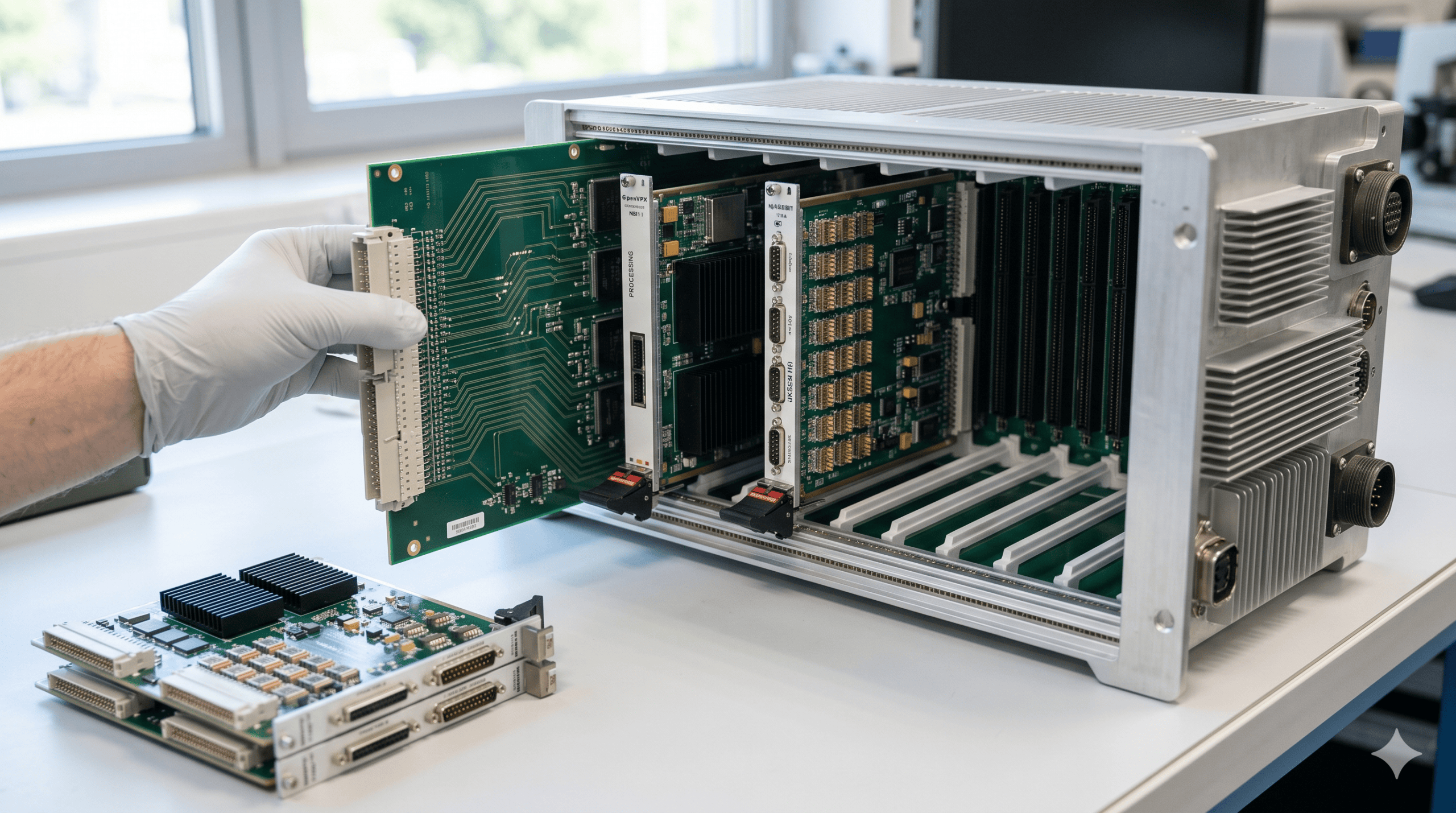
If you build rugged mission hardware, you’ve probably heard “MOSA” and “SOSA” used in the same breath—sometimes like they mean the same thing. They don’t. But they are connected, and understanding that connection makes it easier to design platforms that can evolve without constant rework.
MOSA is the mindset
MOSA (Modular Open Systems Approach) is the big-picture idea the DoD has been pushing for years: stop building one-off, tightly coupled systems that are painful to upgrade. Instead, design systems that are:
- Modular (swappable building blocks)
- Based on open interfaces (not vendor-unique mystery connections)
- Easier to compete and sustain over the long haul
For a hardware integrator, MOSA shows up as a requirement that basically says: “Make this easier to upgrade later.” That’s the intent—future-friendly architecture, fewer lock-ins, smoother tech refresh.
The catch is that MOSA is broad. Two different teams can both claim “MOSA” and still build very different systems.
SOSA is how that mindset gets enforced in mission compute
SOSA (Sensor Open Systems Architecture) takes the MOSA philosophy and makes it more concrete for sensor processing and mission computing—think ISR, EW, radar, signal processing, and other high-performance embedded workloads.
SOSA doesn’t reinvent everything. It leans on established standards in the VPX ecosystem and says, in effect: “Use these standards in a consistent, interoperable way.” That consistency is the point. It reduces the “interpretation gap” that turns open architectures into custom integrations anyway.
So if MOSA is the direction, SOSA is the rulebook for a major chunk of defense embedded computing.
Where VPX fits (and why people bring it up)
SOSA-aligned systems live in the OpenVPX world, with standards maintained by groups like The Open Group and VITA. In practical terms, that means integrators spend a lot of time thinking about:
- Slot counts and payload mix
- Backplanes and high-speed serial fabrics
- Cooling approaches (conduction, airflow-through, hybrid)
- Power delivery and system services
- Ruggedization and qualification
SOSA often gives you the “shape” of the system—profiles, expectations, conventions. But the platform still only works if the hardware execution is solid.
The simplest way to separate MOSA and SOSA
- MOSA says: build systems so parts can be swapped and upgraded over time.
- SOSA says: here’s how to structure mission-computing hardware so that the “swaps-and-upgrades” idea actually works across vendors.
That’s why “MOSA-compliant” can be a fuzzy statement, while “SOSA-aligned” usually implies more specific design constraints and integration expectations.
What this means for hardware integrators day to day
Even with profiles and standards, no program is truly plug-and-play. The real work lives in the details that sit between modules—exactly where chassis, backplanes, and integration choices matter.
Backplanes and signal integrity
On paper, connectors and pinouts can look compatible. In reality, high-speed performance comes down to routing, stackup decisions, and validation. Backplanes are where “it should work” and can turn into “why is this failing in the test?”
Thermals and mechanics
Cooling methodologies isn’t an afterthought—it drives the enclosure design, module retention, airflow paths, conduction interfaces, and ultimately reliability. Whether the system is conduction-cooled or airflow-through, thermal decisions ripple through the entire platform.
Power delivery and margin
As payloads get more power-hungry, you need clean distribution, good monitoring, and enough margin for transients and future module swaps and expansions. A platform that’s “open” but fragile on power isn’t really open.
I/O, timing, and critical services
Timing, management, and I/O mapping are easy to gloss over early and painful to fix later. The more disciplined you are here, the easier upgrades become without redesigning the surrounding system.
Qualification and production reality
A modular architecture is only valuable if it can be built and sustained. DFM/DFT (design for manufacturing/design for test), supply chain planning, and environmental qualification determine whether “open” scales beyond a prototype.
Why the MOSA/SOSA relationship really matters
The whole reason people care about MOSA and SOSA is optionality. Programs want to be able to refresh compute, add acceleration, swap interfaces, or pivot suppliers without restarting the entire design.
Hardware integrators are the ones who either protect that optionality, or eliminate it.
Turning open-architecture goals into real hardware
MOSA sets the expectation: modular, open, upgradeable systems. SOSA makes that expectation more practical for mission computing by tightening how standards are applied so interoperability is achievable.
At the end of the day, the standard isn’t the finish line, the platform is. Atrenne helps teams bridge that gap with rugged chassis, backplanes, and integration work that turns open-architecture intent into systems you can build, qualify, deploy, and refresh with confidence.