
Why Small Form Factor Is Having a Big Moment
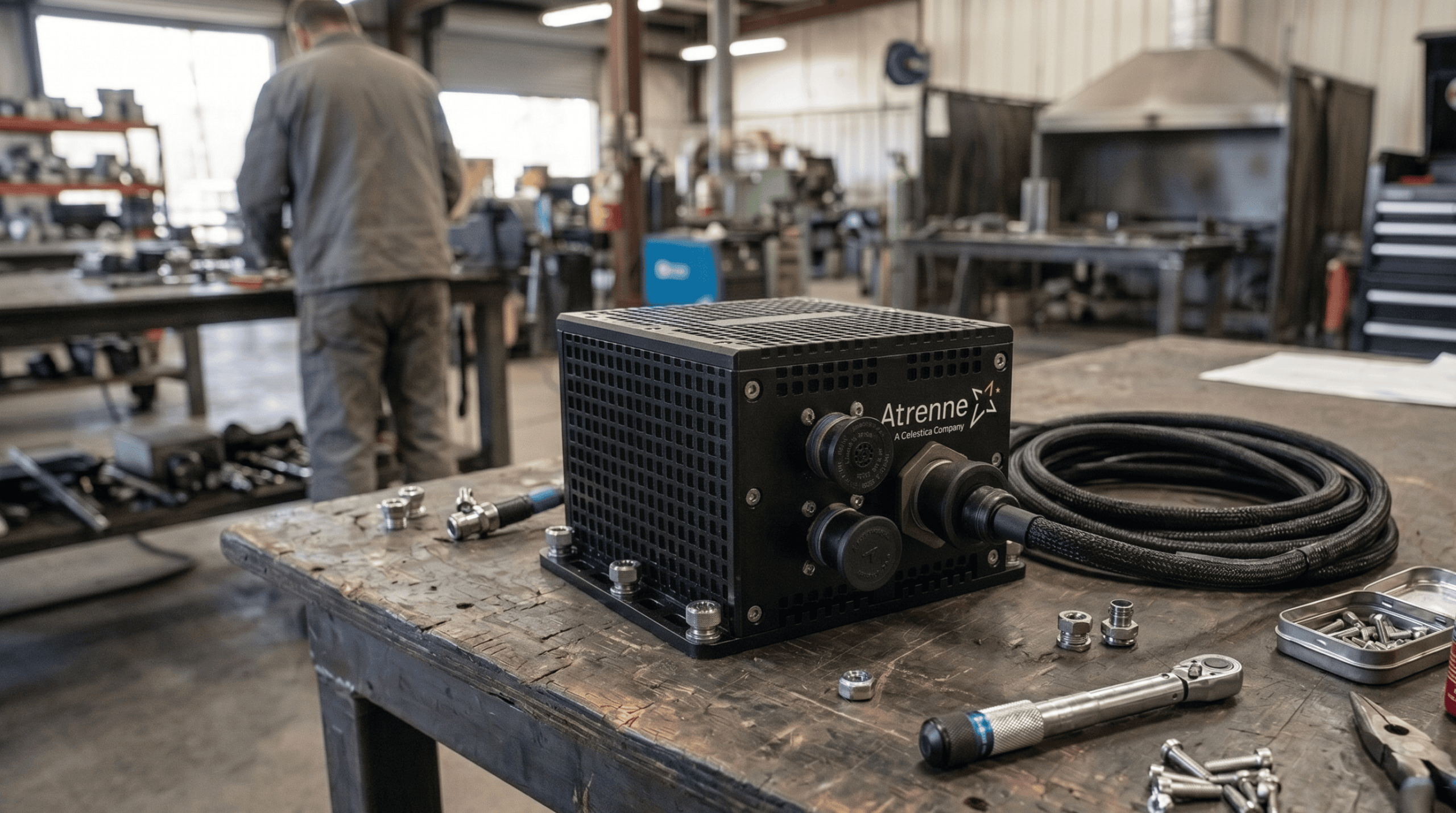
Modern edge platforms—from uncrewed vehicles and next-generation avionics to SATCOM terminals and rugged IoT gateways—are under pressure to do more in less space, with less power, and on faster timelines. That convergence is exactly why Small Form Factor (SFF) architectures are having a moment. Among them, VITA 90-VNX+ stands out as a compact, modular path to deploy high-performance compute and sensing at the tactical and industrial edge without compromising environmental ruggedness or lifecycle needs.
This article unpacks the “why now,” highlights what VNX+ brings to the table, and outlines how Atrenne helps program teams move from concept to deployment.
The Market Forces: Size, Speed, Sustainability
1) Size: Shrinking SWaP‑C without shrinking capability
Space on airframes, pods, turrets, and vehicle bays is finite. Yet the demand for onboard AI/ML, advanced RF, and multi‑sensor fusion continues to climb. SFF architectures like VNX+ prioritize:
- SWaP‑C optimization: Higher compute density per cubic inch with board‑to‑board efficiency and right‑sized I/O.
- Environmental ruggedness: Conduction‑ and Air‑Flow‑Through‑friendly mechanicals, wedge‑lock retention, and proven thermal interfaces to survive shock, vibe, and altitude.
- Right‑scaling: Not every platform needs full OpenVPX card envelopes; VNX+ enables capabilities to fit where 3U/6U VPX won’t.
2) Speed: Faster cycles from prototype to production
Programs are compressing development timelines. Mission software changes weekly; hardware can’t lag for months. VNX+ helps accelerate:
- Rapid integration with modular card sets, standard interconnects, and proven backplane topologies.
- Design portability between lab and platform using ruggedized development enclosures and production‑grade chassis with the same electrical intent.
- Supply resilience by leveraging open standards and multi‑vendor ecosystems instead of one‑off bespoke builds.
3) Sustainability: Performance with a lighter footprint
Edge systems carry tight power budgets and increasingly stringent sustainability goals across the lifecycle:
- Lower power draw at the edge reduces platform fuel burn and thermal load.
- Thermally efficient chassis extend component life and reduce maintenance.
- Open, modular designs simplify tech refresh—swap a card, not a system, avoiding unnecessary waste.
Where SFF Shines: Representative Use Cases
- Edge AI and sensor fusion: In‑pod or on‑mast processing where space and power are tight but latency matters.
- Electronic intelligence (ELINT) & spectrum sensing: Distributed RF capture and pre‑processing close to antennas for higher fidelity with minimal cabling loss.
- Navigation and timing: Resilient PNT enhancement at the edge with small, thermally stable modules.
- Rugged industrial control: Railway, energy, and heavy‑equipment systems requiring compact, serviceable compute.
- SATCOM & data links: Modem and crypto adjacency to RF front ends to minimize latency and improve throughput.
Engineering Considerations That Make or Break SFF
Getting SFF right is less about shrinking a board and more about system engineering discipline. The most successful deployments balance:
Signal Integrity
- Backplane routing that respects loss budgets at multi‑gigabit rates.
- Controlled‑impedance laminates and via strategies that maintain eye margins.
- Connector selection and placement tuned for crosstalk and skew.
Thermal Architecture
- Conduction paths from die to chassis using heat frames, gap fillers, and precision machining.
- Air‑Flow‑Through or liquid‑assisted options where watts‑per‑slot exceed conduction limits.
- Early CFD plus empirical validation in environmental stress screening (ESS).
Power Integrity
- Right‑sized power trees with low ripple and transient response for mixed‑signal loads.
- Derating and margining practices for altitude, temperature, and long‑life reliability.
Mechanical & Environmental
- Wedge‑lock clamping forces validated for shock and vibe.
- Corrosion‑resistant finishes, plating, and gasket strategies for EMI and environmental sealing.
- Serviceability features (blind‑mate guides, maintainable filters, removable modules).
Atrenne’s Approach to VNX+ and Small Form Factor Success
Atrenne helps program teams compress schedule risk and deliver reliable SFF hardware that’s ready for the mission environment:
SOSA‑Aligned Design DNA
Our chassis, backplanes, and module mechanics are built around open‑systems principles for multi‑vendor interoperability and long‑term sustainment.
Custom Backplanes, Done Right
We co‑engineer stack‑ups, materials, and routing to hit SI budgets at speed—whether your payload is CPU/GPU compute, high‑rate RF, or storage‑heavy.
Thermal Solutions Without Guesswork
From conduction‑only to advanced Air‑Flow‑Through, we design the thermal path early and validate it with analysis and ESS so performance holds at temperature and altitude.
Manufacturing Depth
In‑house machining, metal forming, welding, plating, painting, cable harnessing, electronic assembly, and system integration give you a single accountable partner from prototype to production.
Migration Paths
We provide practical roadmaps to complement existing OpenVPX systems with SFF endpoints, or to migrate select functions to VNX+ for size and power wins—without compromising reliability.
Talk to Our Team
Have a payload in mind—or a platform constraint that’s blocking progress? Let’s map your options. Atrenne can help you ‘right‑size’ with VNX+ and get to production with confidence.