
Precision by Design: Trace Routing, Signal Integrity, and Thermal Considerations in Custom Backplanes
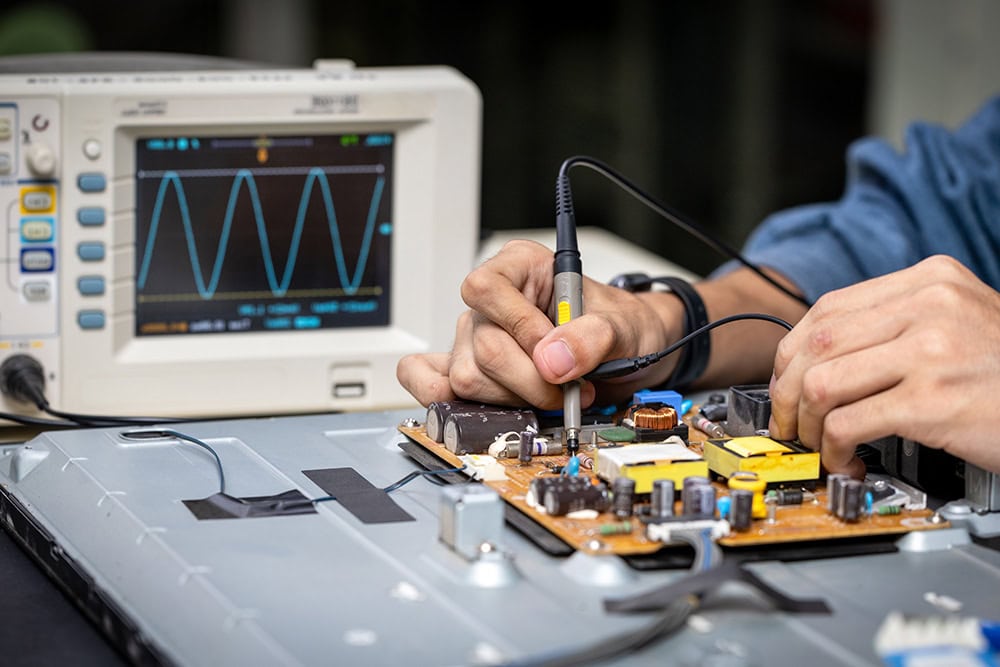
In high-performance systems, the backplane is more than just a passive connector—it’s a precision-engineered interface that drives power, signal speed, and thermal resilience across the entire electronics architecture. As systems grow faster, more compact, and increasingly rugged, the demands on custom backplane design grow with them. From trace routing to signal integrity to thermal reliability, every design decision affects mission success. In this post, we explore the advanced techniques Atrenne applies to ensure our custom backplanes meet the highest standards of performance in the most demanding environments.
Trace Routing: The Art of Connectivity
High-speed systems rely on precise trace routing to maintain performance across differential pairs, minimize latency, and reduce crosstalk. At Atrenne, we use impedance-controlled routing to ensure consistent signal propagation, even in dense multi-layer backplanes.
Key factors include:
- Controlled impedance for high-speed SerDes interfaces
- Length matching for differential pairs and clock signals
- Via optimization to reduce signal degradation
- Segregated power/ground planes to minimize noise
Advanced PCB layout tools and simulation models allow our engineers to visualize and validate trace topologies before a single layer is fabricated.
Explore Our Solutions:
- SOSA™ / OpenVPX Backplanes – Engineered for speed, density, and modularity
- Custom Backplanes – Collaboratively designed for optimal trace performance or built-to-print.
Signal Integrity: Clean Signals Under Stress
Signal degradation can lead to timing errors, jitter, and ultimately system failure. Atrenne mitigates these risks through:
- Pre-layout signal integrity simulation using industry-standard tools
- Insertion loss and return loss modeling for long traces and connectors
- Designing for margin, allowing for manufacturing and environmental variations
- Material selection with low dielectric loss (e.g., FR408HR, Megtron 6)
Our team also applies de-skewing techniques and shielding strategies to preserve signal quality in even the harshest EMI environments.
Explore Our Resources:
- SOSA Development Chassis – Ideal for signal-intensive prototyping
- OpenVPX Solutions Overview – Modular architectures designed for electrical performance
Thermal Considerations: Designing for Heat
High-speed electronics generate significant heat—and backplanes are no exception. Poor thermal performance can affect impedance, material properties, and lifespan.
Our thermal strategies include:
- Thermal vias and copper pours for heat dispersion
- Backplane airflow modeling in conjunction with chassis-level cooling
- Material selection based on thermal conductivity and coefficient of expansion
- Component placement to avoid localized hotspots
We also work closely with customers to integrate conduction-cooled, air-over-conduction, and hybrid cooling techniques into the mechanical enclosure design.
Explore Our Capabilities:
- 3U/6U OpenVPX Air-Over-Conduction Cooled Chassis – Engineered for thermal management in rugged deployments
- Integrated Packaging Solutions – Holistic design to address heat, signal, and mechanical integrity
Why It Matters
Custom backplanes are more than just interconnect boards—they’re the precision backbone of today’s rugged embedded systems. Whether carrying high-frequency RF signals or multi-gigabit Ethernet lanes, the combination of optimized trace routing, validated signal integrity, and engineered thermal pathways ensures your system performs under extreme environmental conditions.
Partner with Atrenne for Mission-Ready Backplanes
When failure is not an option, your backplane must do more than connect—it must enable. Atrenne’s vertically integrated approach—from simulation to manufacturing—delivers custom-engineered solutions that meet the electrical, mechanical, and thermal demands of today’s defense, aerospace, and industrial platforms.
Let’s build something extraordinary.