
What Is CMOSS? A Guide to the Army’s C5ISR/ELINT Modular Open Suite of Standards
Modern missions demand real-time situational awareness, rapid adaptability, and advanced electronic intelligence capabilities. For decades, land vehicles and aircraft relied on proprietary, single-purpose “stovepipe” electronics. Each new radio, electronic intelligence (ELINT) suite, or navigation receiver required its own dedicated box, cabling, display, and power source—severely straining vehicle space, power, and thermal limits.
To solve this integration bottleneck, the U.S. Army established ‘army CMOSS ’ (C5ISR/EW Modular Open Suite of Standards). Aligned with the Department of Defense’s mandated Modular Open Systems Approach (MOSA), CMOSS defines a comprehensive suite of open hardware, software, and RF architectures. By consolidating communications, signals intelligence, electronic intelligence, and precision navigation into a unified chassis, CMOSS transforms defense electronics from isolated hardware islands into a seamless, upgradable ecosystem.
Why the Military Shifted to Open Standards
Legacy defense electronics architectures present operational and economic limitations. Installing new capabilities historically required multi-year integration cycles, extensive vehicle modifications, and proprietary cabling overhauls.
The army CMOSS standard addresses these legacy challenges by focusing on three key priorities:
- SWaP-C Reduction: Consolidating standalone boxes into a single multi-slot chassis drastically reduces Size, Weight, Power, and Cost (SWaP-C).
- Eliminating Vendor Lock-in: Mandating open, non-proprietary physical and logical interfaces allows program offices to source components from competing vendors.
- Accelerating Tech Insertion: Upgrading platform capabilities no longer requires replacing entire electronics suites; personnel can swap out individual plug-in cards (PICs) in minutes.
The Five Core Pillars of the CMOSS Architecture
The army CMOSS framework integrates five complementary open standards spanning hardware, RF, networking, software, and timing layer requirements:
- OpenVPX (VITA 65) and SOSA Alignment: Establishes standardized slot profiles for 3U and 6U plug-in cards (PICs) and backplanes, ensuring hardware interoperability across manufacturers.
- MORA (Modular Open RF Architecture): Standardizes RF signal distribution, enabling processing units to share centralized antennas and power amplifiers instead of requiring dedicated antennas for every radio system.
- VICTORY: Provides an open vehicle-level data bus that enables networked systems, displays, and sensors to share tactical data across the platform.
- Portable Software Layer (REDHAWK, SCA, FACE): Decouples mission applications from processing hardware, allowing signals intelligence (SIGINT) and communication algorithms to run portably on compliant hardware.
- Centralized Assured PNT: Distributes Position, Navigation, and Timing data from a shared GPS/inertial navigation card across all installed chassis cards, eliminating redundant GPS receivers.
Architectural Comparison: Legacy vs. CMOSS
| Capability Metric | Legacy Defense Systems | Army CMOSS Open Architecture |
| System Footprint | Multiple independent boxes cluttering cabin space. | Single chassis footprint with shared power and cooling. |
| Upgrade Speed | Multi-year overhauls requiring structural re-wiring. | Card-level swaps performed in the field in days or weeks. |
| Data Fabrics | Low-speed proprietary serial buses creating data silos. | Standardized high-speed 100GbE and PCIe Gen 4/5 fabrics. |
| Interoperability | Locked to original equipment manufacturer (OEM) hardware. | Cross-vendor compatibility via SOSA and OpenVPX profiles. |
| Logistics Tail | Unique spare parts for every standalone box. | Common backplanes, chassis, and standardized replacement cards. |
Field Deployment: From Architecture to CMFF Hardware
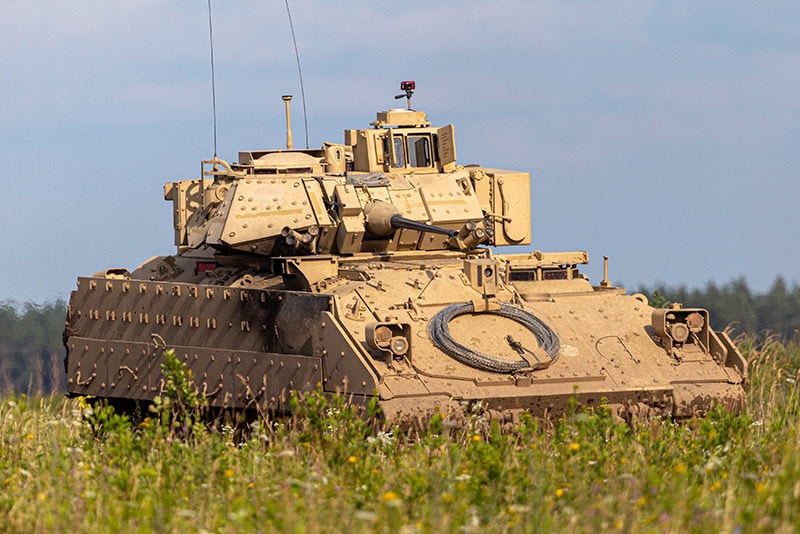
Implementing army CMOSS in ground vehicles—primarily via the CMOSS Mounted Form Factor (CMFF) program—and airborne platforms demands hardware capable of withstanding harsh mission conditions. Open architecture software and cards rely entirely on ruggedized physical chassis, high-speed backplanes, and thermal management systems to function reliably under high vibration, thermal stress, and heavy electromagnetic interference (EMI).
This physical infrastructure layer must support high-speed data transmission—such as PCIe Gen 4/5 and 100GbE—while adhering strictly to MIL-STD-810 for environmental stress and MIL-STD-461 for EMI shielding.
Deploying CMOSS Solutions with Atrenne
Building high-reliability CMOSS deployments requires chassis and backplane engineering designed specifically for open-architecture standards. Atrenne provides field-tested physical infrastructure designed to meet strict army CMOSS and SOSA technical standard requirements:
- Gen 4/5 OpenVPX & SOSA® Backplanes: Supporting up to 25 Gbaud per lane (100GbE and PCIe Gen 4/5) using advanced VITA 46.30 RT3 connectors for signal integrity.
- Rugged ATR Enclosures: Air Transport Rack (ATR) chassis supporting air-over-conduction, Air Flow-Through (VITA 48.8), and liquid cooling for ground and airborne environments.
- Lab-to-Field Systems: From 11-slot SOSA-aligned development chassis for prototyping to ruggedized small form factor (VITA 90 VNX+) enclosures for fielded production.
Pairing CMOSS software and hardware cards with ruggedized Atrenne chassis and backplanes reduces program risk, accelerates deployment timelines, and ensures long-term platform adaptability.